What Guitar Size Is Right for Me?
Choosing the right guitar size is an essential step, whether you’re a beginner or an experienced musician. The size of the instrument influences not only your playing comfort but also the tone and how easily you progress. So, how do you determine the ideal size for yourself or your child? This article walks you through the different guitar sizes available, the criteria to consider, and a few tips for making a great choice.

Guitar sizes: what are the options?
Before diving into the selection criteria, let’s look at the different guitar sizes available on the market:
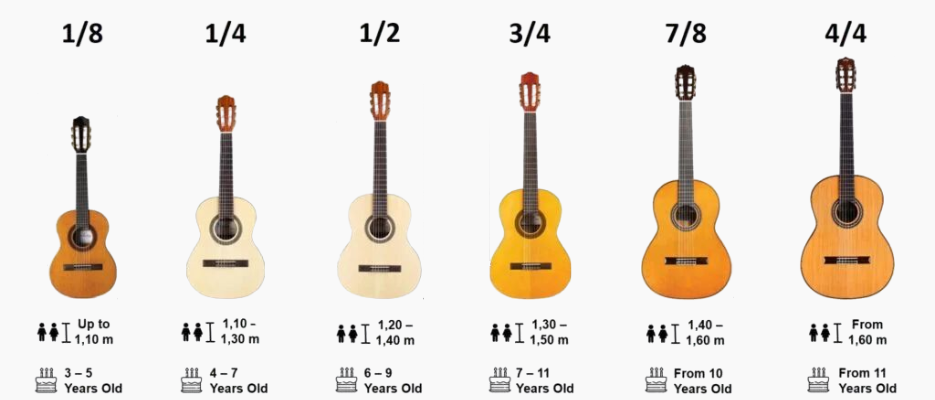
1. 4/4 guitar: the standard size
Dimensions: The 4/4 guitar, also called full size, measures about 100 cm.
Who is it for?: Ideal for adults or teens over 1.50 m.
Advantages:
A rich and complete sound palette.
Suitable for most musical genres.
Default tuning: E–A–D–G–B–E (EADGBE).
2. 7/8 guitar, also called Senorita
Dimensions: About 95 cm, just a bit smaller than a 4/4 guitar.
Who is it for?: Perfect for teenagers or anyone between 1.40 m and 1.60 m looking for a compromise between a 3/4 and a full-size guitar.
Advantages:
Offers extra comfort for smaller hands without sacrificing tonal richness.
Highly appreciated for classical and flamenco styles.
Default tuning: E–A–D–G–B–E (EADGBE).
3. 3/4 guitar, also called “Cadette”: the intermediate size
Dimensions: About 90 cm, slightly smaller than a standard guitar.
Who is it for?: Children aged 7 to 11, or adults looking for a compact travel guitar.
Advantages:
Easier to handle for smaller hands.
Excellent for beginners.
Default tuning: E–A–D–G–B–E (EADGBE).
4. 1/2 guitar, also called Requinto: for young children
Dimensions: Between 83 and 85 cm.
Who is it for?: Children aged 6 to 9.
Advantages:
Adapted to the size and strength of young players.
Lightweight and easy to handle.
Default tuning: A 1/2 guitar can be tuned standard (EADGBE) or A–D–G–C–E–A (ADGCEA) to suit its shorter scale.
5. 1/4 guitar: for the very young
Dimensions: Around 75 cm.
Who is it for?: Children aged 4 to 7.
Advantages:
Perfect for first steps in music.
Designed to maximize comfort for very young players.
Default tuning: A–D–G–C–E–A (ADGCEA).
6. 1/8 guitar, or guitalele
Dimensions: Smaller than a 1/4 guitar; it’s a hybrid between a guitar and a ukulele.
Who is it for?: Traveling musicians and early childhood music education.
Advantages:
Compact and highly portable.
Tuned in A, it offers a unique sound.
Default tuning: A–D–G–C–E–A (ADGCEA).
7. Other specific sizes
Some guitars are designed for particular needs:
Travel guitars, small and lightweight, are ideal for musicians on the move.
Baritone guitars, with a longer scale, suit players who love deeper tones.
Default tuning: Baritone guitars are often tuned B–E–A–D–F#–B (BEADF#B).
How to choose the ideal size?
Several criteria should guide your choice of guitar size:
1. Your height and body shape
A guitar that’s too large can be difficult to play, especially when reaching the higher frets.
Conversely, a guitar that’s too small can hinder your technique and produce a less powerful sound.
2. User’s age
For children, it’s essential to pick a guitar suited to their age:
4–7 years: 1/4 guitar.
6–9 years: 1/2 guitar.
7–11 years: 3/4 guitar.
11+ years: 4/4 guitar (if height allows).
3. Playing comfort
Comfort is crucial, especially if you plan on long practice sessions.
Try several sizes to find the one that suits your body.
Check that you can easily reach notes along the neck and play chords without strain.
4. Musical style
Certain styles call for specific sizes or types of guitars:
A classical guitar is often recommended for beginners or for classical and flamenco music.
A folk or electric guitar is better suited to modern styles like rock, pop, or blues.
5. Player’s goals
For a young beginner: a lightweight, easy-to-handle guitar is ideal.
For a committed adult: choose a quality full-size guitar.
For a traveler: a travel or foldable guitar can be an excellent choice.
Comparison of guitar types by size
| Size | Type | Advantages | Drawbacks |
| 1/8 | Guitalele | Compact hybrid, easy to carry | Limited sound compared with a guitar |
| 1/4 | Classical | Perfect for very young children | Less powerful sound |
| 1/2 | Classical/Requinto | Great transition for older kids | Less suitable for adults |
| 3/4 | Classical/Folk | Versatile, ideal for kids and teens | Less powerful than a 4/4 guitar |
| 7/8 | Senorita | Compromise between 3/4 and 4/4, rich tone | Slightly less common |
| 4/4 | Classical, Folk, Electric | Full and versatile tone | Can be challenging for small hands |
Why is guitar size so important?
Impact on comfort
A poorly fitted guitar can cause wrist, shoulder, or back pain. This may discourage beginners and slow their progress.Sound quality
Larger guitars, like 4/4 models, generally offer a richer, more powerful sound, while smaller guitars produce lighter tones.Technical development
For children, a well-suited guitar encourages better posture and makes it easier to learn fundamental techniques.
Tips for choosing your guitar
Here are some practical tips to help you:
Try before you buy
If possible, visit one of our physical stores to test different models. You’ll be able to assess comfort and tone in person.Ask for advice
Need personalized guidance? Our phone advisors are available Monday–Friday, 9:00–18:00, and Saturday, 10:00–18:00. They’re all musicians and can steer you to the ideal model.Think ahead
For children, it’s tempting to choose a guitar that only just fits right now. However, opt for a slightly larger size if the child is growing quickly.Brand choice
Invest in a quality guitar, even for a beginner. Brands like Yamaha, Cordoba, or Fender offer well-designed models in every size.Mind the weight
A guitar that’s too heavy can be uncomfortable to hold—especially for kids!
Conclusion: find your ideal size
Your ideal guitar size depends on several factors: your height, age, skill level, and musical preferences. Take the time to try several models to find the one that fits you perfectly.
Hot Sellers
More




News
More